The river is not dead: Care, culture, and the Bogotá hydrocommons
Restoring human relationships with rivers must focus on local agency and ecological entanglement, not just large-scale industrial intervention.
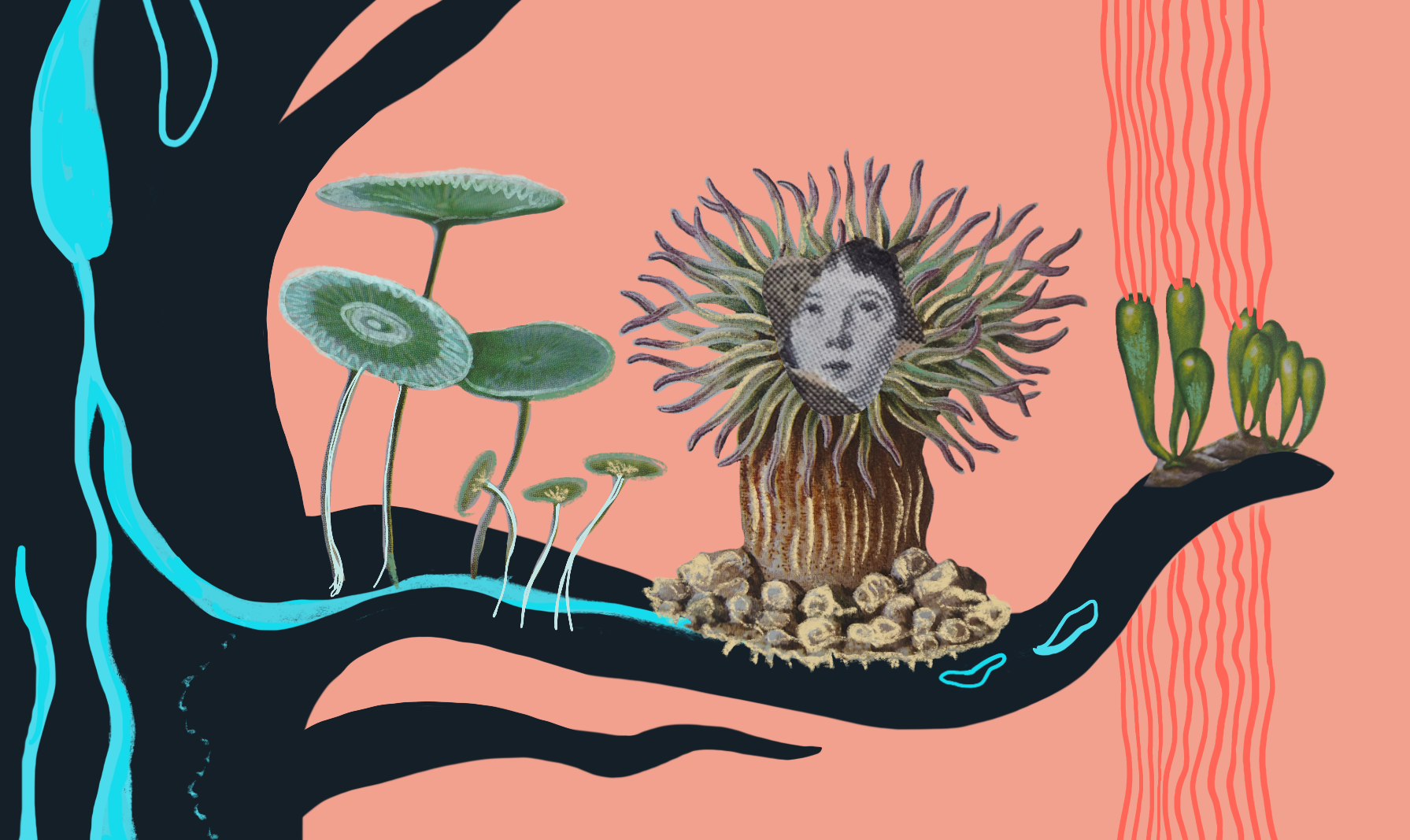
For decades, Colombia’s Bogotá River, its waters choked by domestic and industrial waste, has been labeled “biologically dead.” Legal rulings and massive infrastructure projects have promised to restore it, but these efforts often reduce the river from a living being with its own agency to an object of technocratic management. At entre—ríos, an arts-led research platform, we argue for a different paradigm, one that understands rivers as vibrant bodies embedded in webs of human and more-than-human relations and deserving not just restoration but also care.
Through our project RÍO BOGOTÁ, we propose that cultural practices like storytelling, communal meals, and artistic research can help reweave human relationships with rivers. These practices offer critical counterpoints to dominant narratives that sideline local agency and ecological entanglement in favor of distant expertise and industrial-scale solutions. By prioritizing community stewardship, we contribute to growing global calls for more-than-human rights and a shift toward hydrocommons ethics.
We propose that cultural practices like storytelling, communal meals, and artistic research can help reweave human relationships with rivers.”
From infrastructure to intimacy
In 2014, a landmark Colombian court ruling known as the Sentencia del Río Bogotá mandated restoration of the river. There are three main components to the court’s comprehensive strategy. The first is the environmental restoration of the basin through measures to conserve the hydrological cycle and biodiversity; initiatives to improve water quality and reduce pollution; and basic sanitation projects, including treatment schemes and dynamic water-quality modeling to determine the optimal location for a second treatment plant. The second, institutional coordination, aligns national, regional, and local planning tools to implement a unified basin management structure to oversee the river hydrosystem. The third, citizen participation and education, is aimed at raising awareness about water resources and promoting source recycling and cleaner production practices. While the Sentencia del Río Bogotá was a legal victory in principle, its implementation has centered infrastructure—mainly the construction of giant wastewater treatment plants—rather than grassroots care. The health of the Bogotá River is still primarily measured in technoscientific terms: oxygen levels, decontamination targets, and cost-benefit metrics.
This technocratic framing distances everyday people from their river. It suggests that only large institutions can “fix” it, effectively outsourcing care to experts without concrete experience of the river. Meanwhile, campesinos are sidelined. These members of peasant and rural communities live with the river every day and depend on it for their livelihoods, including agricultural practices, small and medium-scale cattle farming, community-based water management, forest restoration efforts, ecotourism and environmental education projects, and other activities. Our work seeks to challenge dominant models by foregrounding local stories, ancestral knowledge, and the river’s own rhythms.
The river is alive
Contrary to official declarations, the Bogotá River is not dead. Its waters still pulse with life, and its tributaries support biodiversity and communities. We collaborated with Indigenous elders, artists, river guardians, engineers, and others to conduct fieldwork along the river’s course, testing water quality, mapping community gardens, and listening to local stories. We found that even in its most polluted stretches, the river seeks to metabolize waste and regenerate itself. Rainfall dilutes contaminants; nighttime flows recover oxygen. The river breathes.
We found that even in its most polluted stretches, the river seeks to metabolize waste and regenerate itself. Rainfall dilutes contaminants; nighttime flows recover oxygen. The river breathes.”
For Indigenous Mhuysca elders like Abuela Blanca Nieves, the Bogotá River is kin. She describes it as born from the “womb” of the páramo (a high Andean ecosystem) and flowing down to the chucuas (wetlands) of the Sabana. This view echoes ancestral practices like pagamento, a kind of offering, that treat rivers as sacred relatives rather than inert infrastructure.
Toward the hydrocommons
The concept of the hydrocommons, inspired by feminist scholar Astrida Neimanis, invites us to rethink rivers as not just resources but also relational bodies. We are all downstream and upstream of one another. Our consumption, waste, and governance practices ripple across time and space, connecting us to ecosystems and beings we may never see.
Yet dominant water policies often enclose rivers within technoscientific and legal frameworks that obscure these relationships. They erase local knowledges, emotional ties, and histories of coexistence. By contrast, hydrocommons thinking centers mutual care, interdependence, and collective responsibility. It invites us to move from management to kinship.
Caring through culture
Through RÍO BOGOTÁ, we developed three curatorial projects to cultivate what we call hydrocommons cultures: ways of living, feeling, and acting that recognize our interdependence with water and other life forms.
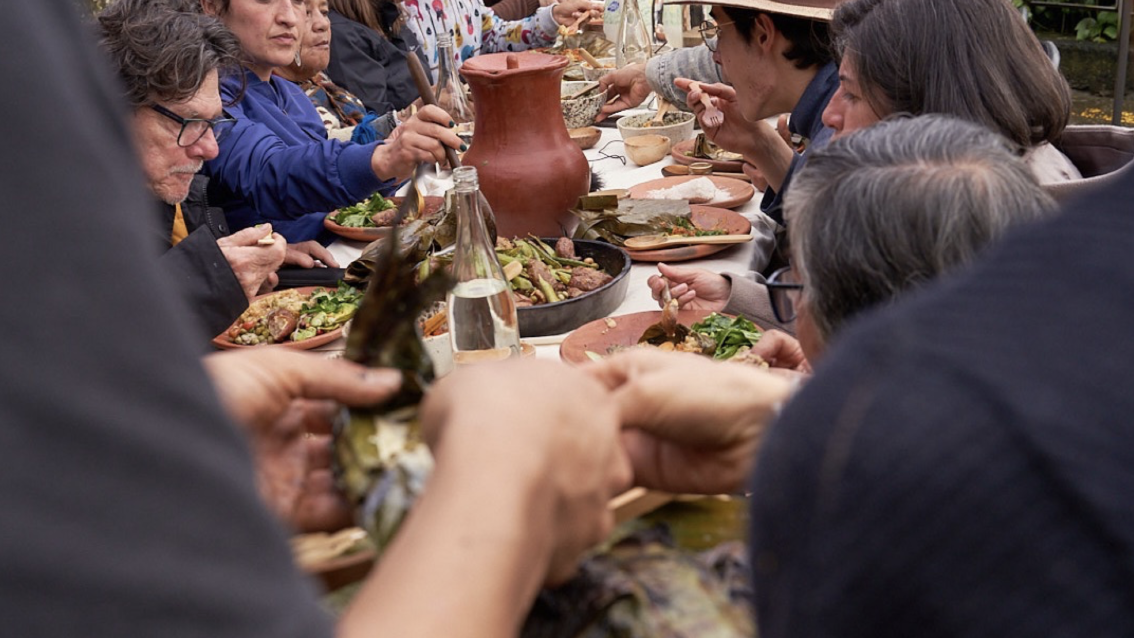
First, in 2023, we organized a communal meal beside Tequendama Falls, where the river carries the full weight of Bogotá’s waste. Our multispecies ritual of gratitude was inspired by early twentieth-century riverside gatherings called piquetes. We collaborated with Cristina Consuegra and Carlos Alfonso, who worked together with inhabitants of the watershed to create a menu of traditional dishes featuring local ingredients. On the day of the meal, each guest held water from the river’s source in their hands before eating. The event honored both human and nonhuman lives entwined in the river’s flow.
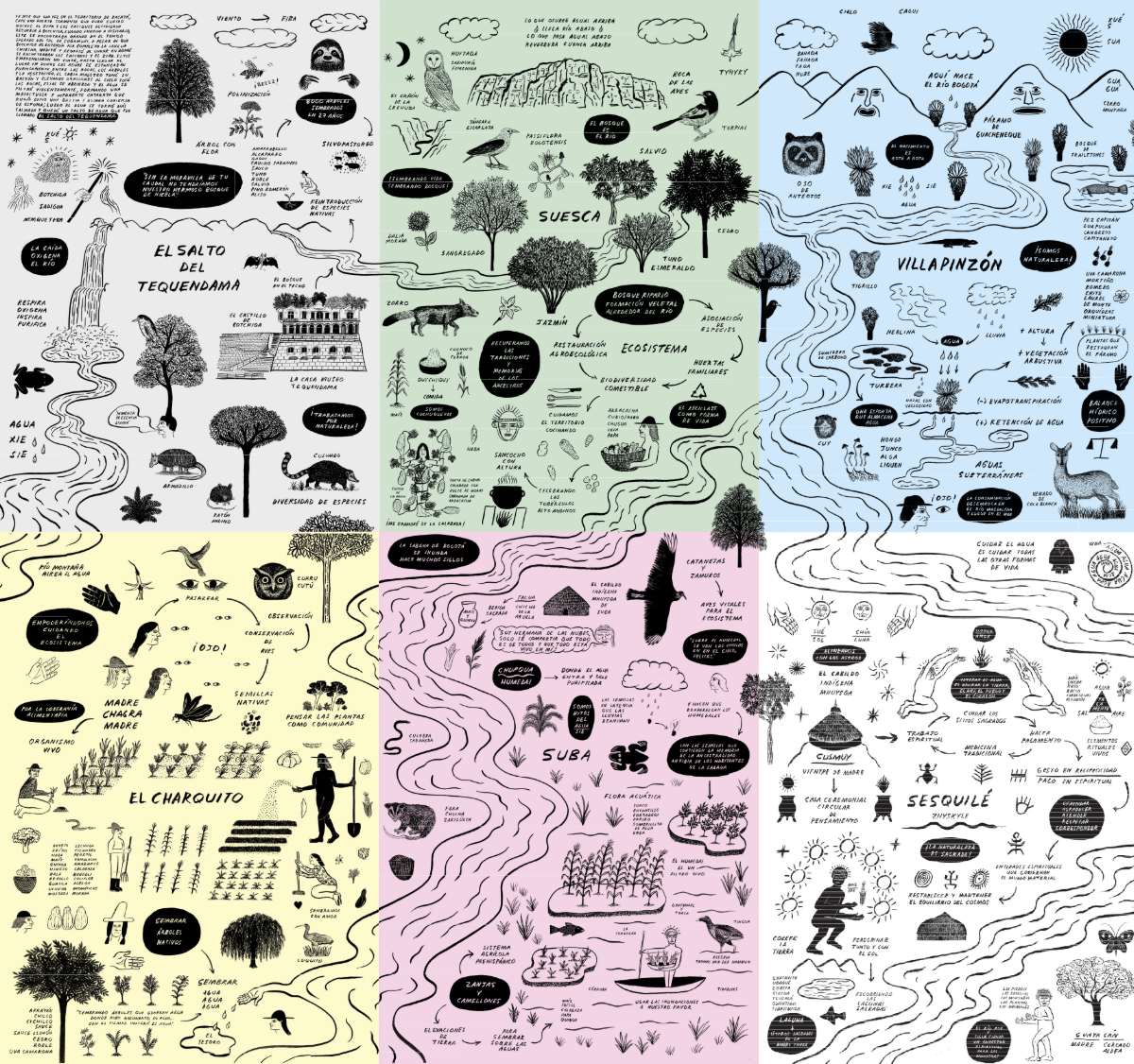
The same year, we co-created Cómo cuidar un río (How to Care for a River) (2023), a publication and map that documents community members who engage in organic farming, environmental education, wetland protection, and cultural preservation along the river. Illustrated and coauthored with local participants, the map doesn’t depict the river as a line on a page but as a network of stories, species, and daily practices. Shared in schools, libraries, and public workshops, it invites readers to listen to the river and imagine their own roles in its care.
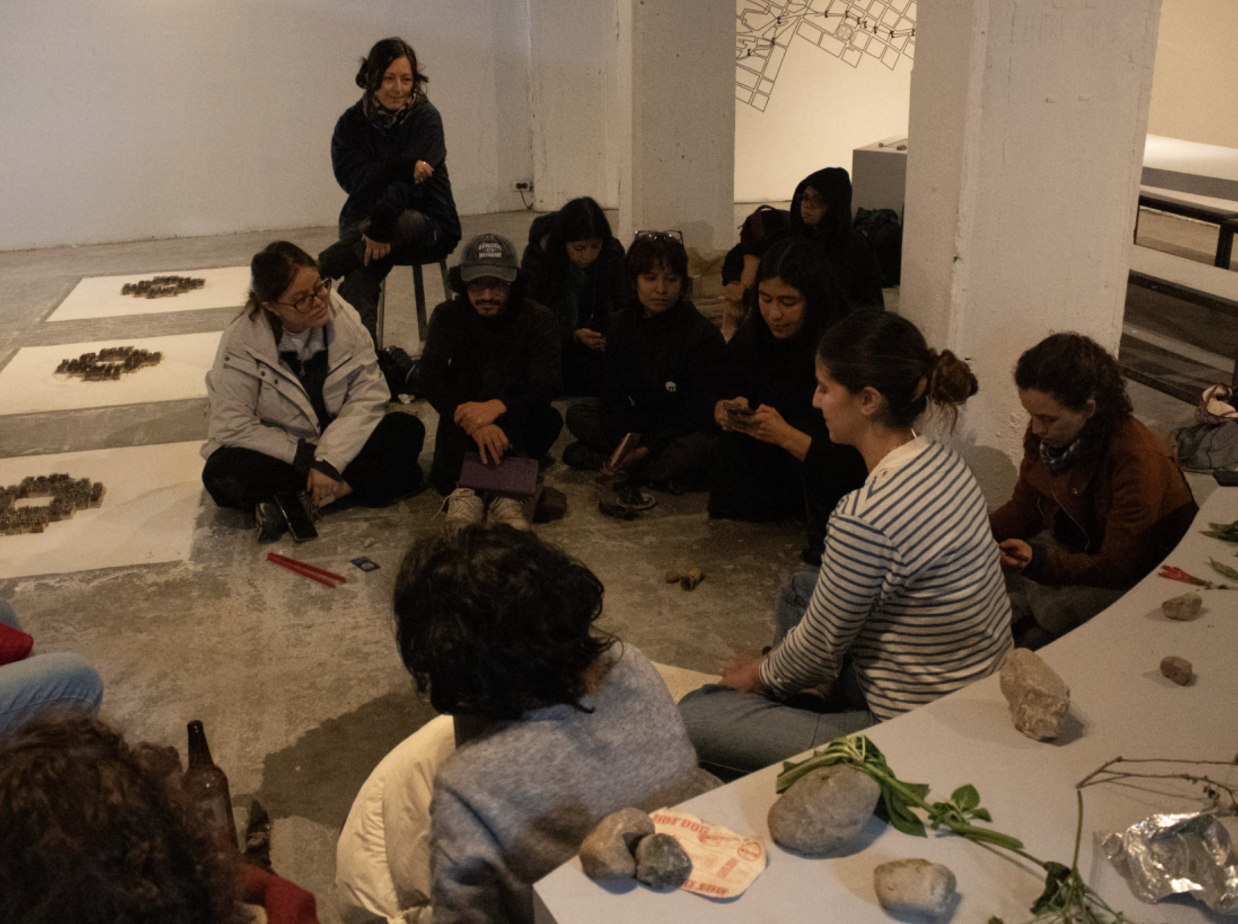
Finally, as part of the 2024 exhibition el mismo lugar al mismo tiempo, entre—ríos curated the project ¿Vamos al río? (Shall We Go to the River?) at Espacio Odeón in Bogotá. We explored the Vicachá River, a tributary now buried beneath the city, walking its hidden path, listening to its sounds through amphibious instruments, and convening a workshop with stones gathered from the riverbed. We invited participants to imagine what the river might say if we visited it. Many responded with tenderness, calling the river “abuelo,” “tía,” or even “blood.”
Our work shows that care for rivers is already happening—through seeds sown in community gardens, through stories shared over meals, through children drawing hummingbirds that live by the water. These are not sentimental gestures. They are acts of resistance and of future-building.”
Why this matters
Rivers like the Bogotá are not isolated cases. Across the world, water bodies are treated as infrastructure—channeled, commodified, buried. At the same time, movements for the rights of rivers, from Aotearoa New Zealand’s Whanganui to Colombia’s Atrato, are gaining momentum. These legal innovations are important, but they must be rooted in cultural and ecological practices that enliven rivers as beings.
Our work shows that care for rivers is already happening—through seeds sown in community gardens, through stories shared over meals, through children drawing hummingbirds that live by the water. These are not sentimental gestures. They are acts of resistance and of future-building.
The Bogotá River is not dead. It is silenced and suffocated but still alive. To truly care for it, we must go beyond industrial projects and judicial rulings. We must listen, walk, eat, plant, and mourn with it. In doing so, we rejoin the hydrocommons—and begin to imagine new ways of living with our watery kin.

