Punk Law: Lessons from Fungi
From the MOTH Program’s new editorial newsletter, The MOTH Dispatch.
Watching Prince at work, I kept thinking that the futures of ecology and technology are as entangled as the mycelial networks that Prince has captured in unprecedented detail. In case you’re wondering, Prince is the robot that scientists collaborating with the Society for Underground Networks (SPUN) custom-built to peer into the microscopic lives of mycorrhizal fungi — the underground mesh that holds soils together and nourishes plants and life on Earth. I expected fungal networks to look busy, constantly moving minerals and carbon around. But I never imagined them to be so stunningly beautiful. Made visible by Prince’s magnifying powers, the fungi’s fractal shapes have the soothing familiarity of tree branches and leaf veins. Yet the lines are softened by the roundness of spores, as in a nanoscopic Christmas tree.
I expected fungal networks to look busy, constantly moving minerals and carbon around. But I never imagined them to be so stunningly beautiful.
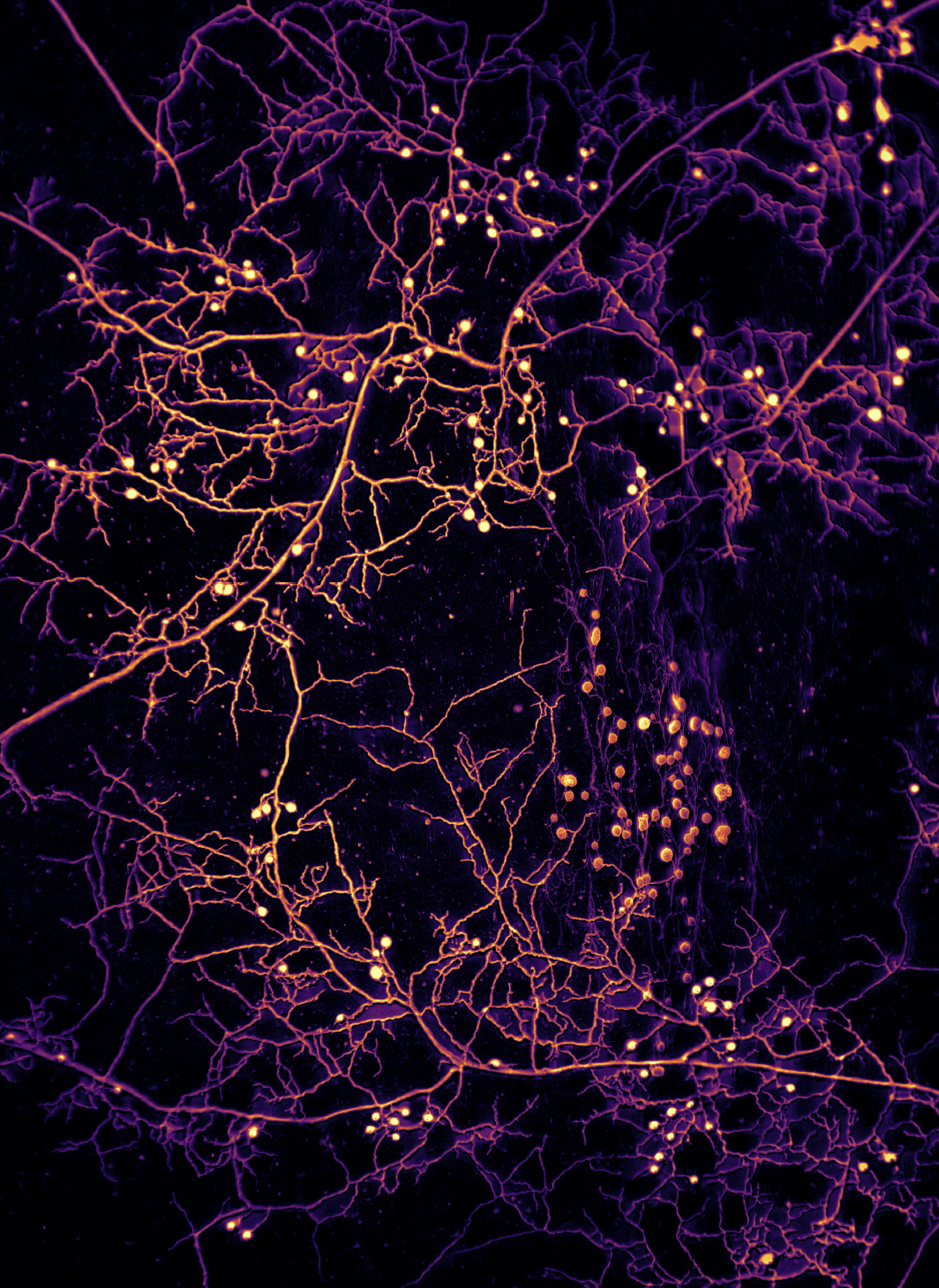
Talking with physicist Tom Shimizu, my host at the AMOLF lab in Amsterdam, it became clear to me that the pursuit of beauty is as much of an inspiration for his work as the pursuit of knowledge. The AMOLF/SPUN team are probably the first humans to see mycelial networks in such level of detail. Their (literally) groundbreaking research has shown that fungal networks are forms of decentralized intelligence that solve complex logistical problems. Fungi build adaptive and efficient supply chains. They make decisions about where to channel the minerals they collect in order to receive carbon from plants, where to grow new paths to shorten travel time, and where to widen their minuscule thread-like tubes (hyphae) to increase traffic to areas with high demand. When I asked Tom what he felt when he first saw life move through the networks, he drew a long, slow breath. I understood it as the sign of awe, equal parts fascination and admiration.

Like mycorrhizal networks, we have shared, exchanged and enriched the distinct nutrients we each concoct: law and science.
The path that brought me to the lab was just as fascinating. I was there as part of the collaboration between MOTH and SPUN to protect fungi in law and policy around the world. Like mycorrhizal networks, we have shared, exchanged and enriched the distinct nutrients we each concoct: law and science. The visible fruiting bodies of our partnership include the recently launched Underground Advocates Program, a training program that equips mycologists with the tools they need to turn their science into legal and social change. It also includes a study on the consequences for law and policy of SPUN’s Underground Atlas — the first global effort to map the Earth’s fungal network, made possible by e-DNA and machine learning technologies. In an upcoming article in Ecology Law Quarterly, we show that this new world map of underground biodiversity calls for a profound revision of environmental legal frameworks. Strikingly, by focusing largely on animals and plants, the law has left underground ecosystems unprotected —ecosystems that are home to 59% of the planet’s biodiversity, store 75% of Earth’s terrestrial carbon, and are essential to the food systems that humans and non-humans alike depend on.
Fungi are master decomposers. They break down the toughest materials, from rocks to oil to nuclear waste. What if we enlisted those powers to transform the law, one of the most resistant social structures? Fungi give us precious cues for the changes we need at this critical time in human and planetary history. Perhaps their greatest transformative power is their invisibility. In a world of influencers and incessant self-promotion, mycelial networks engineer whole ecosystems in the quiet and the dark. That is how they infiltrate bodies and minds. Before you know it, they get into you. They have certainly gotten into me. You cannot get this close to fungi without being changed.
Once you see reality from a fungal perspective, you cannot unsee it. As for many others, my entry point into this viewpoint was Merlin Sheldrake’s Entangled Life. While reading the book was a portal into a novel way of seeing the world, working closely with Merlin for several years has been a portal into a different way of being in the world. If it wasn’t a zoo-centric, aboveground analogy, I would say that Merlin walks the talk. From what I can tell, he lives the life of a mycelial network, constantly making connections among ideas and people, sharing resources, and defying boundaries. Symbiosis at work.
It took us only a few conversations to realize that, despite inhabiting wildly distinct professional ecosystems, we were both weavers. We became entangled in threads of collaboration and friendship with his fellow mycologists, and later with the lawyers, scientists, Indigenous leaders, artists and storytellers at the heart of MOTH.
In addition to the talents of invisibility and symbiosis, fungi have shown me that moral indignation drives the movement for the rights of nature as much as it fuels the human rights movement. This became clear to me when I first met Giuliana Furci, the founding director of the Fungi Foundation. Listening to Giuliana tell the story of how fungi have been wrongly excluded from environmental law despite being a whole kingdom of life, and how she helped pass pioneering legislation in Chile that put fungi on a par with animals and plants, I recognized the passion that I had seen and felt in working for the rights of marginalized human communities. The connection seemed clear to me: fungi had been excluded not for lack of ecological significance, but because the law had not seen them. The issue was one of discrimination. After I suggested that we use ideas from antidiscrimination law to advance justice for fungi in environmental law, Giuliana, Merlin and I threw ourselves into the Fungi Foundation’s 3F (Flora, Fauna, Funga) campaign to fully incorporate fungi into conservation frameworks.
You cannot get this close to fungi without being changed.
Fungi have a lot more to teach those of us seeking new ways to advance social and ecological justice. Mycelial networks experiment with different strategies, growing simultaneously in different directions. They adapt quickly to their environment, developing new connections and fine-tuning their trade with plants. Their intelligence is distributed, solving problems without a commanding center.
But if I had to pick one gift from fungi and those who know them well, it would be the power of mischief. They all gleefully defy well-established assumptions, operating both as individuals and networks and creating new possibilities while decomposing old structures. They are punk. As SPUN’s leader, Toby Kiers, has put it, theirs is “punk science” because they’re “trying to cross boundaries and disciplines and not accept the state of the world as a given, while celebrating science that is rooted in creativity.”
Watching Toby proclaim “punk science” at the recent events celebrating her Tyler Prize win (the “Nobel prize” for environmental science), I recognized the gleam of mischief that I had seen in her during our fieldwork in the Amazon and other activities of the MOTH collective. I have told her that MOTH is also doing “punk law” by bridging disciplinary divides, experimenting with new legal actions, and questioning the law’s human supremacism.
Doing punk law with mycologists and the rest of the MOTH collective has been serious fun. It is laughter-filled hard work, with concrete results like a MOTH documentary on Indigenous and Western understandings of the underground, produced in collaboration with the Sarayaku people of the Ecuadorian Amazon, the Fungi Foundation and SPUN.
Joy gets the job done.

