Out of the Bunker
The Gaia Theory invites us to think of the Earth as a living organism and to recognise the interdependence of all its inhabitants.
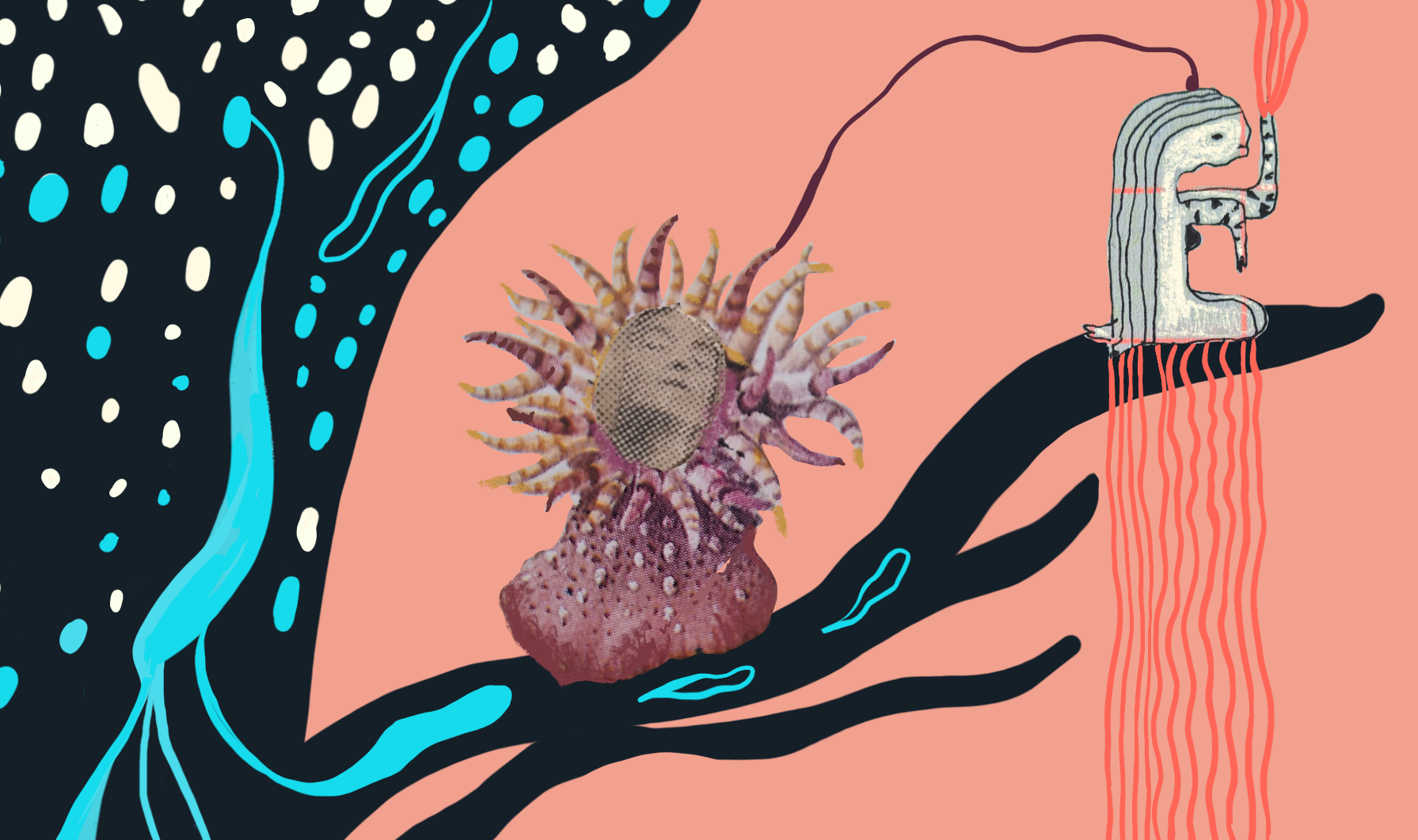
What if the root cause of our current crises were the disconnect between humans and the Earth? In recent times, the Gaia Theory has gained scientific and social traction. This hypothesis, proposed by James Lovelock, views the planet as a living, self-regulating system. This would mean our survival requires a planetary consciousness that recognises the importance of the relationships between all beings.
How do you feel about the Earth? That is a question few of us get to answer these days. It seems too big, too abstract, perhaps a little hippy. We lack the language, we are too engrossed in more immediate matters of individual survival, and, even if we can find time to think on a global scale, this line of thought can take us in uncomfortable directions. Just look at the state of the world right now: war, political extremism, climate crisis, nature breakdown, inequality. Who wants to dwell on that? Most people today would rather think in smaller, more manageable doses – nations, tribes, families, selves.
But what if that inability to connect with the Earth is the cause of our contemporary problems, a severing of root from trunk that makes leaves wither, branches fall, collapse inevitable?
I have been drawn to this question in recent years for two main reasons: first, a closer acquaintance with indigenous cultures in my Amazon rainforest home, of which more later; and second, more than 80 hours of interviews with the late British scientist, inventor and philosopher of ecology James Lovelock, who is best known as the father of the Gaia Theory of the Earth.
Looked at on this planetary scale, Life (with a capital L) is much more about interdependence than competition.
The Gaia hypothesis suggests our planet behaves like a living organism, maintaining a steady temperature, salinity, acidity and chemical composition through the constant interaction of the biosphere and the atmosphere. In this theory, the billion, trillion, quadrillion discharges of everything – from bacteria to Blue Whales – create and self-regulate the air we breathe, the sky above our heads and the climate that we rely on. Looked at on this planetary scale, Life (with a capital L) is much more about interdependence than competition. Nothing can be understood outside of its place in the Earth system, which encourages a holistic, integrated perspective that is sharply at odds with the more popular trend in modern science of creating specialist disciplines and breaking subjects down into smaller and smaller units of study, such as atoms and genes.
Gaia was a popular concept in the late 1980s and early 1990s, which was an era of unusually strong planetary consciousness. Cold War divisions were starting to break down, the institutional racism of apartheid was defeated in South Africa, the governments of the world came together to pass what is still the world’s most successful environmental agreement: the Montreal Protocol, which phased out ozone depleting chemicals. This was a time when there were still high hopes for what was commonly known as “the international community” – a term that nobody would dream of using in today’s age of Trump, Putin and Netanyahu. It’s heartbreaking that our children have never experienced how good it can feel to come together in this way.
Back then, Gaia was popularly – and often derogatively – associated with New Age spiritualists. That was the context in which I first heard about the theory and, as a result, I confess I was initially sceptical: a nice idea, I thought, but probably rooted in wishful thinking and spurious pseudo-science. I had no inkling then who Lovelock was. In fact, few people did. In public, he presented himself as an outsider, an independent and a rebel against the academic establishment. Even after he became a globally renowned scientist in the 1990s, the origins of his Gaia Theory were buried in corporate confidentiality agreements and Britain’s Official Secrets Act.
It was only much later, when I came to write his biography, that I learned Lovelock had been deeply embedded in the Anglo-American military-industrial complex. In two years of fascinating interviews at the end of his long life (Lovelock died in 2022 on his 103rd birthday), he told me things he had never been able to reveal before: how he had been chief scientific adviser to the Shell oil company and warned them in the 1960s that fossil fuel combustion was disrupting the climate; how he worked as a “Mini Q” for UK intelligence agencies, building gadgets for spies and bomb disposal techniques for British troops in Northern Ireland; how his invention of the world’s most sensitive chemical detection instruments was used to discover the ozone layer damage caused by chlorinated fluorocarbons; and how he had helped to persuade right-wing British prime minister Margaret Thatcher to adopt a strong environmental policy in 1989. Putting all of this together, it was clear that Gaia Theory was far more than just a New-Age belief; it came from the heart of the industrial establishment and was based on cutting-edge science and the world’s most advanced atmospheric data.
Initially ignored, then mocked by mainstream scientists, Gaia Theory is now a cornerstone of Earth system science. Its primary proposition – that atmospheric gasses are biologically maintained – is widely accepted. Another of its central arguments – that the Earth functions like a homeostatic cybernetic system – has paved the way for research into tipping points, such as the loss of polar ice sheets, the dieback of rainforests or the slowdown of ocean currents, that might push this system dangerously out of equilibrium.
Gaia Theory also appeals on an emotional and spiritual level. This is partly because, at the suggestion of Lovelock’s neighbour, the Nobel Prize-winning author William Golding, it was named after the Greek goddess of the Earth. For the religiously inclined, this name, and the idea of self-regulation, hinted at a benevolent god-like working of the Earth system. Lovelock publicly refuted this interpretation, which he knew would weaken his credibility in the eyes of scientific peers, but suggested Gaia might be an alternative to religion for agnostics, and he privately confided to me that he sometimes prayed to the goddess.
The origins of the theory were deeply tied up in Lovelock’s personal relationships. The idea of a living earth was conceived during an affair with a brilliant NASA analyst called Dian Hitchcock, who worked alongside Lovelock in the 1960s at the Jet Propulsion Laboratory in Pasadena, California, on a project to search for life on Mars. The two lovers realised the flatlining Martian atmosphere indicated the planet was dead, which made them start wondering why the gases of the Earth were more vivacious. In one letter, Hitchcock posited the concept of a planetary “great animal” – a precursor to Gaia. Another essential contributor was the American biologist Lynn Margulis, whose theory of symbiosis and studies of microbes provided the theoretical mechanism for Life to regulate the atmosphere.
There were countless other important contributors to Gaia Theory, from shadowy industrialists like the Head of Shell Research, Baron Victor Rothschild, to visionary scientists such as Carl Sagan. More of a contested space than a single unchanging theory, it has been repeatedly challenged, championed or re-imagined by the likes of Richard Dawkins, Ford Doolittle, Stephen Schneider, David Abram, Mary Midgeley and Tim Lenton. One of the strongest recent takes was by the French philosopher Bruno Latour, who emphasised the political potential of Gaia. Compared to the passive evolutionary role of Life according to Darwinism, Latour said Gaia Theory showed that Life was an active participant in the creation of the environment. It has agency.
For me, that is one of the reasons why Gaia is more relevant than ever as an antidote to the narrow, selfish and ultimately self-destructive forces exemplified by Donald Trump. Far-right politicians have long taken a lead from biology, which they selectively reference to suggest particular behaviours are “human nature” or “only natural.” Charles Darwin’s Theory of Natural Selection is often cited as justification for capitalist competition and the economic survival of the fittest. Richard Dawkins’ concept of the Selfish Gene, which suggested that all life is driven by a genetic-level struggle against rivals, was music to the ears of neoliberals and far-right extremists in the UK. When you start thinking about survival purely as a selfish fight in an ever-narrower arena, then it is hardly surprising that “success” comes to be seen as billionaires in bunkers watching on while the rest of the world burns. The rules of the game of survival have been set for that outcome, by our dangerously limited (mis)understanding of biology.
How different the situation would be if we considered Life from a planetary Gaian perspective.
If we were to recognise that all individuals and all species are interdependent, survival would become a matter of working together to restore a homeostatic balance: fresh air, clean water, fertile soil, a tolerable temperature, abundant nature, a stable climate, peace of mind and a healthy home.
Then, we might start changing our political, economic and financial systems to reward investment that strengthens the habitability of the Earth and penalise activity that knocks it out of kilter. We might look for ways to reform our incomplete democracy by representing future generations and other species in decision-making. We might consider ecocide in our laws and global administrations in our governance. Who knows, we might even start to cool our planet, grow our forests and enjoy abundance instead of fearing extinction.
Humanity’s brief history on this planet reminds us that change will come, either in the form of apocalypse and revelation or reimagining and reinvention.
In the age of Trump, that may seem naive or impossible. But no age, no president, no individual and no system lasts forever. Humanity’s brief history on this planet reminds us that change will come, either in the form of apocalypse and revelation or reimagining and reinvention. And when that time comes, most likely after some form of planetary disaster, we may well appreciate a greater planetary consciousness.
It does not have to come from Lovelock and Gaia. The understanding that humans are part of nature has been around for millennia and takes different forms in different places. Where I live, in the Amazon, I frequently encounter indigenous thinkers who talk of the forest as a living entity or as part of their family, or who see themselves as part of a forest (biosphere) holding up the sky (atmosphere). Most now have Starlink Internet access, cell phones, solar panels and other forms of modern technology, but they are proud too of the ancestral traditions and techniques to plant trees, add nutrients to the soil, create forest gardens and build up nature – adding more to its resilience and our shared chances of survival. Gaia Theory is the closest that western science has come to understanding the importance of those interactions, of recognising humanity’s part in a greater whole and in identifying the ultimate unit of survival as our world. In the end it is not about individuals, but relationships. Particularly the relationship with our home. Planetary consciousness is the starting point for action and change. So, to revise that initial question: How would you like to feel about the Earth?
Article originally published on the CCCB LAB blog under a Creative Commons licence. Jonathan Watts, 2025. URL: https://lab.cccb.org/en/out-of-the-bunker/
Discover The Many Lives of James Lovelock: Science, Secrets, Spycraft and Gaia Theory, written by Jonathan Watts. Greystone Books (2025).

