Other Ecologies: Pluralizing More-Than-Human Rights Beyond the Settler Imaginary
Repoliticizing the rights of nature movement.
In 2017, New Zealand’s Whanganui River made headlines as the first river in the world to be granted legal personhood. The decision was heralded as a milestone for the rights of nature movement, which has long argued that ecosystems and species have inherent rights. For years, Māori communities fought to have their relationship with the river codified in law, breathing Indigenous cosmologies into a settler-colonial legal order. Their worldview, that the river and humanity are one and the same, was celebrated as a compassionate legal model for recognizing a more interconnected environmental future.
As a graduate student researching water governance, I encountered a different kind of river in the ruins of a Soviet-era irrigation canal in western Uzbekistan. There, a wooden water wheel, charkh falak, spun slowly, coaxed to life by farmers using pre-Soviet techniques. In the twentieth century, the Soviets turned Uzbekistan into a cotton monoculture, reordering human and more-than-human life according to a totalizing extractive agenda. The charkh falak, meaning “wheel of the heavens” in Persian and Uzbek, was a device rooted in local knowledge attuned to celestial rhythms and to the quiet obligation of care, yet discarded by the Soviets in favor of concrete canals and mechanical pumps. Decades later, as the USSR contracted, farmers left without support turned to what remained: oral memory and the subtle engineering of a wooden wheel. The charkh falak turned again, not as a relic but a necessity.
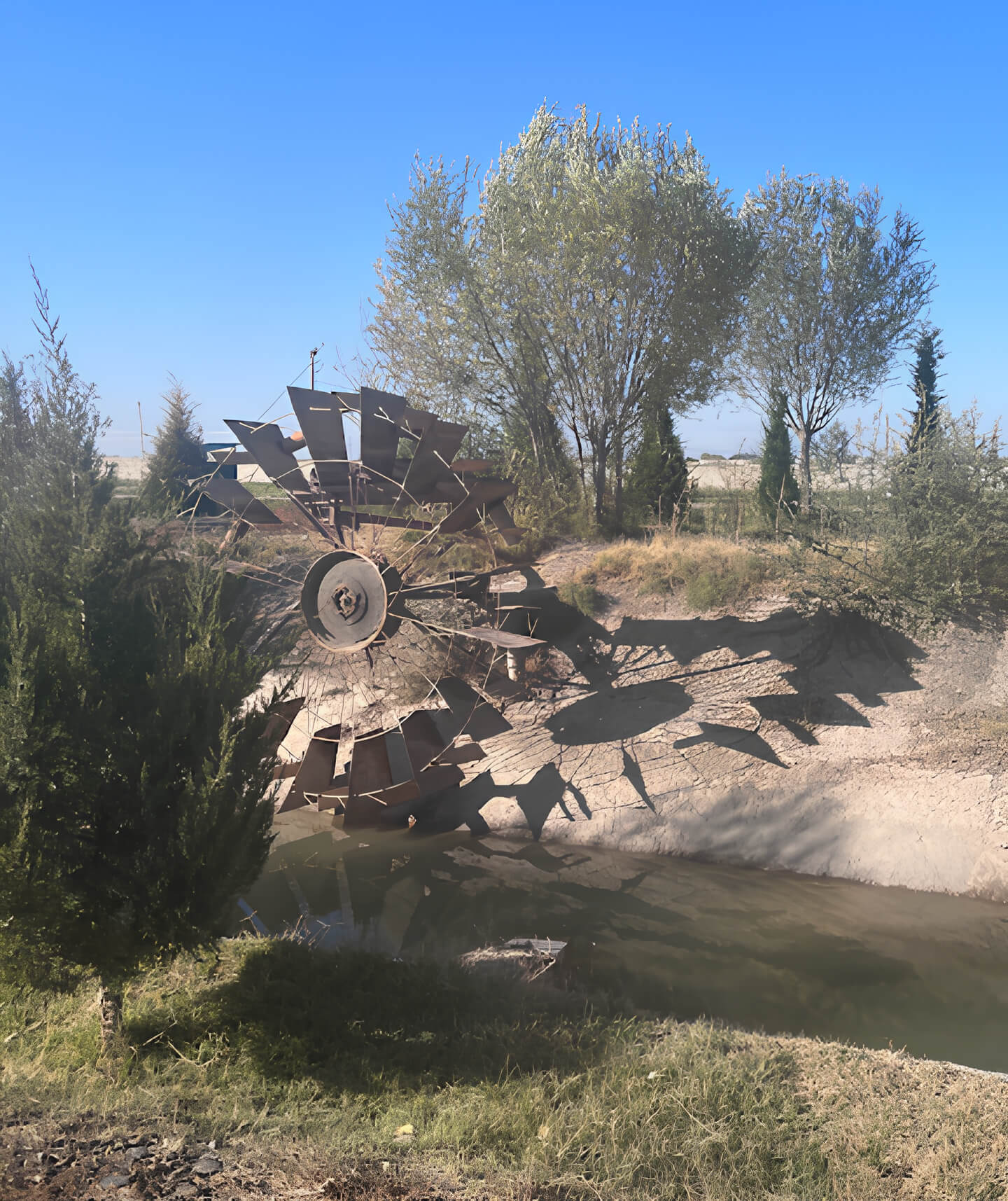
This encounter stayed with me. During my years researching the legal regimes that emerged following the collapse of the Soviet Union in the Zarafshan River valley (a transboundary system between Uzbekistan and Tajikistan), I found myself drawn to more-than-human rights discourse and its invitation to attend to the liveliness of rivers, forests, animals, and ecosystems. Yet, as I immersed myself in this movement, I found that this framework did not map easily onto the regions where I work: greater Central Asia and the Middle East. The assumptions underpinning this discourse, I began to realize, are not as politically neutral as they sometimes seem.
The more-than-human rights discourse typically operates in a post-political register, presenting social reality in neutralizing terms and pushing conflict and antagonism to the margins. It flattens the Global South into a singular conceptual terrain and reduces its actors to two archetypes: the settler who builds infrastructure and governance systems to dominate both human and nonhuman life and the native who, by contrast, resists. This seductive dichotomy—morally charged, visually compelling, and easily legible to Euro-American audiences—obscures political life, failing to account for the plural, splintered histories of imperialism, modernization, and ecological management that have shaped more-than-human life outside the settler-native imaginary. This turn toward moral abstraction often invites legal recognition of nonhuman life without grappling with the redistribution of land, the role of authority, or the project of reparative justice. Without a more situated approach, communities lack the language and legal framework to care for nonhuman life or to revive alternative epistemologies.
Nowhere is this flattening more evident than in the discourse’s treatment of Indigenous knowledge. The turn toward such modes of understanding—often positioned as a counterpoint to Western rationality—produces its own form of fetishization. Indigenous knowledge is heralded as inherently harmonious, timeless, and ecologically pure rather than acknowledged as a dynamic political system embedded in law, territory, and governance.
A worldview that rests on the uncomfortable valorization of Indigenous knowledge lacks the conceptual tools to examine how race, capital, and power have shaped hierarchies within and across communities.
New Zealand’s Whanganui River case exemplifies this problem. The Te Awa Tupua agreement granted the river legal personhood and appointed two guardians—one from the Crown, one from the Māori. Legal scholar Virginia Marshall, however, has questioned whether the rights of nature framework is ever truly emancipatory. While the agreement marked a legal breakthrough, it also subsumes the tribe’s internal legal structures—a robust system that formalizes ownership, succession rights, obligations, and trespass violence—and reinforces gender inequality. Marshall observes that fieldwork conducted by the Australian Law Reform Commission in Aboriginal communities during the 1970s suggested that women were reluctant to speak in mixed groups and decision-making settings. While these findings shouldn’t be treated as definitive accounts of present-day gender dynamics, especially in a postcolonial context, they nonetheless should compel proponents of the environmental personhood movement to question the romanticization of a precolonial past refracted through a postcolonial legal framework (though one perfumed in the language of Indigenous wisdom). What appears as recognition often masks deeper exclusions and can reinforce the global tendency to fetishize Indigenous communities as closer to nature, more primitive, outside of time, or somehow untouched by capitalism. A worldview that rests on the uncomfortable valorization of Indigenous knowledge lacks the conceptual tools to examine how race, capital, and power have shaped hierarchies within and across communities.
The blinkered imaginary of more-than-human rights discourse narrows the geography of political possibility. It centers Euro-American thought and replays colonialism through a familiar dichotomy: the brown native and the white settler. But this binary fails to capture the nuances of contexts and decolonial movements in which the settler-native divide does not exist.
The current more-than-human rights framework does not offer the tools to grapple with regions like Afghanistan, Uzbekistan, and Kurdistan, where ecological and political conditions fall outside the settler-native binary. In these contexts, histories of imperialism, state collapse, and ethnic competition render local cosmologies and more-than-human relations difficult to articulate within existing frameworks. These are places where relationality exists but is invisible within the present language of law.
Repoliticizing the more-than-human means loosening our hold on inherited binaries and confronting the entanglements of power, race, and history that shape ecological life.
What we need is not a wholesale rejection of the more-than-human but a repoliticization of it. We might provincialize this framework by asking what it would look like when mediated through histories that are fragmented, plural, and unresolved. Such actions can create space for voices flattened by a universalizing understanding of the Global South and recognize that not all relational ecologies conform to familiar scripts. Repoliticizing the more-than-human means loosening our hold on inherited binaries and confronting the entanglements of power, race, and history that shape ecological life.
A framework that begins with harmony cannot meet the challenges of the contemporary world; any thinking around the more-than-human must begin with rupture, with the realities of fragmentation, survival, and repair. A truly situated ethics must ask how care is practiced under conditions of loss and how alternative ways of being endure not in pristine landscapes but in broken infrastructures and improvisational returns.
The charkh falak continues to spin not because it was preserved but because it was remade. It survives not as an artifact but as a living response to abandonment. So too must our frameworks turn—not around ideals but around the worlds that persist just beyond the margins of recognition.

