Listening as caring: Cocreating interspecies kinship with Physarum
A participatory art medium for nonanthropocentric dialogues, inspired by observations of the slime mold Physarum polycephalum.
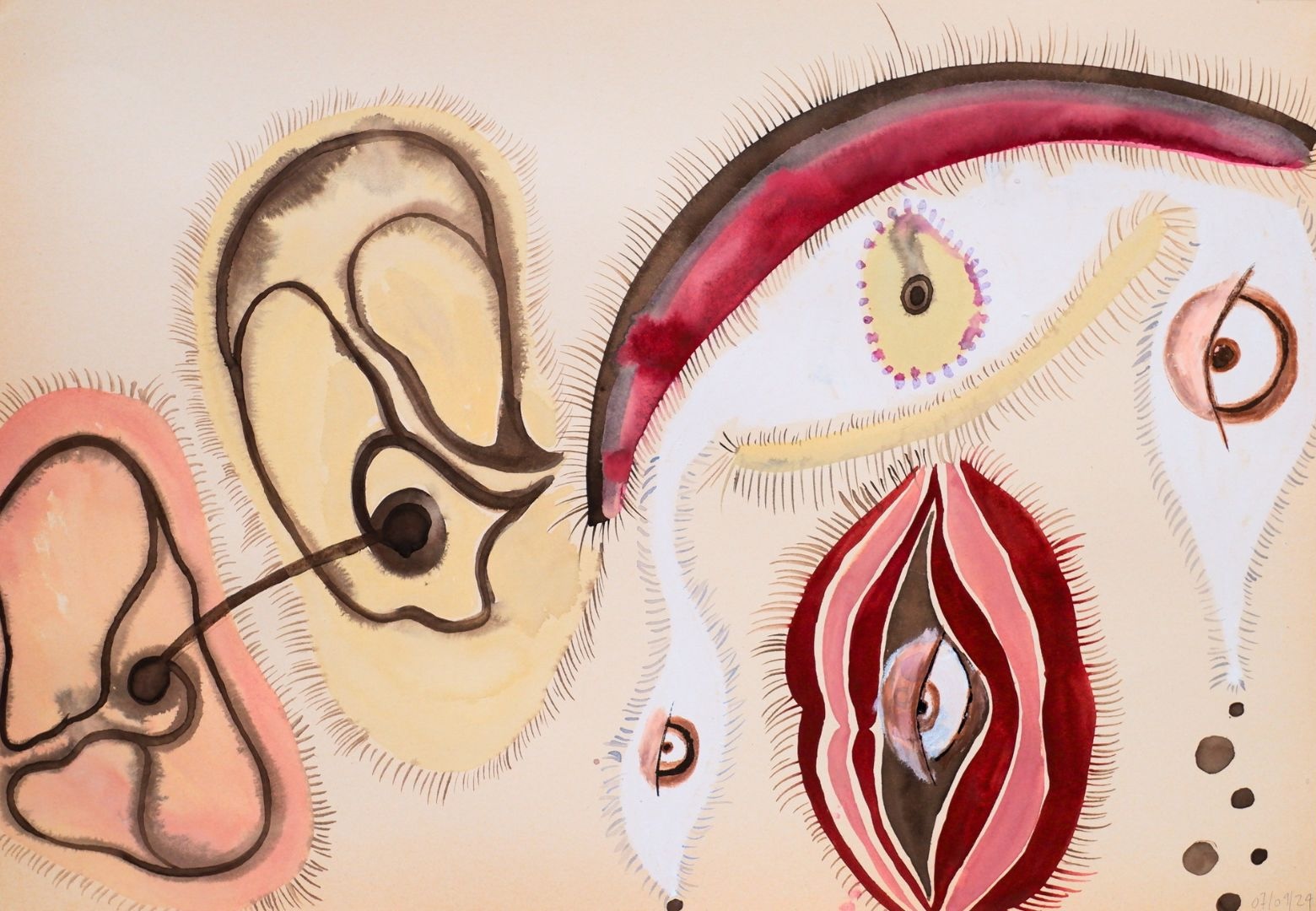
What if the path to environmental resilience begins not with speaking but learning to listen—and learning to listen to not just people but also rivers, stones, microbial worlds, and other nonhuman entities? What does it mean to listen to the voices of others who do not share our languages, forms, or pace of existence? These questions prompt us to expand our definition of agency and open our ears to the more-than-human symphony that has always surrounded us.
In a world shaped by extractive practices and disconnection, listening can become a form of resistance and renewal.”
Participatory fieldwork with Physarum polycephalum, a single-celled plasmodial slime mold known for its networked intelligence, transformed my understanding of listening as an act of care and collaboration across species. In this article, I explore how sound, art, and ecology intersect to foster more-than-human kinship. In a world shaped by extractive practices and disconnection, listening can become a form of resistance and renewal.
Turning to sound as a way of sensing and caring opens space for inclusive, nonhuman perspectives in ecological thinking. The aim is not to romanticize nature but to recognize agency in places we’ve been taught not to look.
Listening as ecological responsibility
Listening is more than simply hearing; it’s a commitment to respond. In the speculative era of the Phonocene, listening transcends aesthetics and becomes an act of ecological care and social awareness, a way to attune ourselves to the entangled rhythms of life. We shift from seeing the earth as a resource to recognizing it as a cocreator in shared survival.
Why does this matter now? Because ecosystems are collapsing. Because technological systems often ignore or flatten the complexities of life. Because our existing models of intelligence and communication exclude the very beings on which we depend. By listening to nonhumans, we challenge the myth of human supremacy and begin to imagine new, interdependent futures based on reciprocal relationships between species.
Why Physarum?
Physarum polycephalum, or slime mold, is a fascinating single-celled organism that solves problems, remembers paths and navigates mazes, creates intricate networks, and adapts to changing environments—all without a brain and often in the dark. But more importantly, Physarum doesn’t “perform” for us. It lives according to its own logic and pace. In my research, I chose to work not on Physarum but with Physarum as a partner in ecological and artistic dialogue.
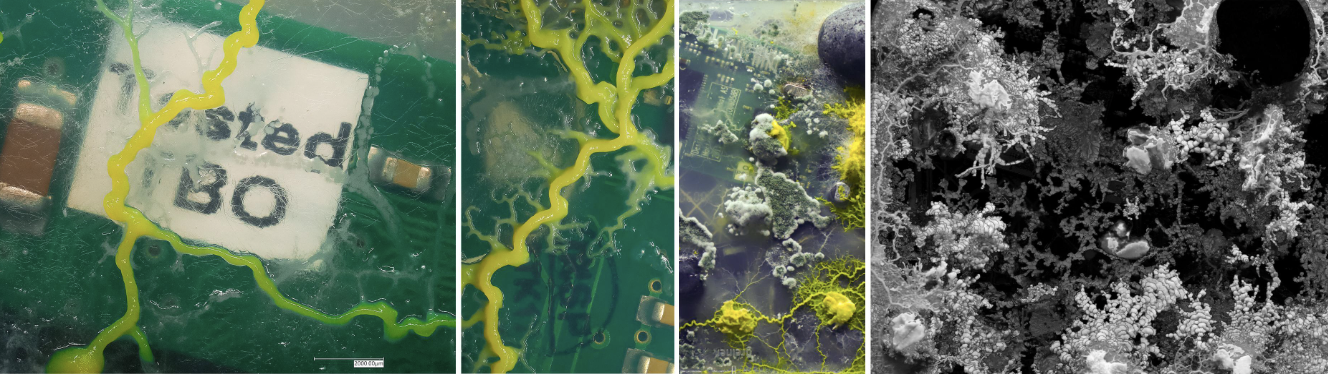
Using tools like discarded electronics, I created environments mimicking today’s synthetic nature—an ecology irreversibly shaped by human activity, technology, and waste—where Physarum could interact with its surroundings. I then used sound synthesis software to translate the trails of data Physarum left behind into sound. The question wasn’t “What does Physarum say?” but “How can we create a space to listen, together?”
The question wasn’t ‘What does Physarum say?’ but ‘How can we create a space to listen, together?’”
From object to collaborator
Drawing on the work of theorists like Donna Haraway, who advocates for kin-making across species, and Bruno Latour, who recognized nonhuman actors as equal participants in shared networks, this project challenges the idea that only humans possess intelligence or agency. At the same time, while nonhuman organisms and materials act with their own forms of responsiveness and intentionality, we require human-designed frameworks—technological, aesthetic, and conceptual—to make these agencies perceptible. This mediation is never neutral; rather, it reveals the collaborative yet asymmetrical nature of more-than-human research and how human intervention both enables and constrains what can be heard, seen, or known.
The e-waste involved in this hybrid artistic experiment highlights the often-overlooked ecological costs of digital technologies. In an encounter between the synthetic and the organic, circuit boards, plastic, and dead devices become the habitat of a living organism capable of dynamic adaptation to this new context. This speculative intervention asks: What if we used technology to create shared ecological experiences instead of dominating nonhuman life?
Making the unheard audible
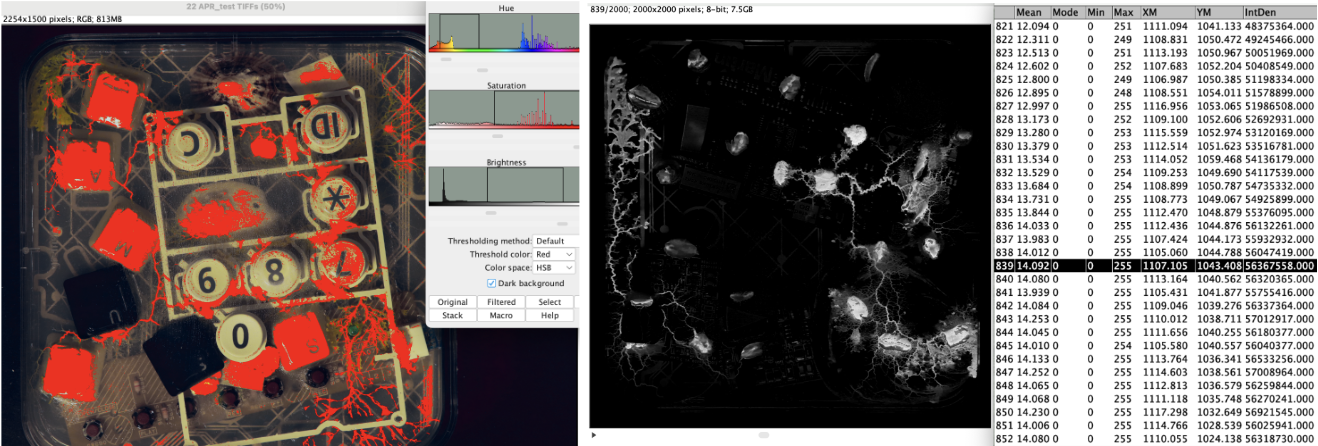
Sonification—translating biological signals into sound—is central to this project. Using software like Max/MSP and ImageJ (Fiji), I mapped Physarum’s bioelectrical activity into audible frequencies. These weren’t melodies in the traditional sense but rhythmic, pulsing, and unpredictable living soundscapes. This process reveals something deeper than data. It asks us to listen in new, less passive ways as attentive participants in an unfolding dialogue with more-than-human life.
Sound bypasses the limits of language. It invites empathy, sensation, and presence. As theorist Timothy Morton suggests, tuning into the “hyperobjects” of planetary systems starts by listening differently. But this comes with responsibility.
Sound bypasses the limits of language. It invites empathy, sensation, and presence.”
More-than-human kinship in practice
While sonification makes nonhuman rhythms audible, it also risks appropriating them. As media theorist Shannon Mattern warns, technological tools can flatten the complexity of nonhuman actors into humanly recognizable aesthetic forms.
This is where the ethical capacity to respond with care, humility, and mutuality, what Haraway calls response-ability, is crucial. Sonification should not reduce Physarum to an instrument but amplify its role as a participant in shared ecosystems. Technology is not neutral. But when used with care, it can become a medium for solidarity across species.
This project centers listening as a key methodology of ecological practice. By integrating discarded human materials and nonhuman biointelligence, it gestures toward possible futures where collaboration and new ecological storytelling replace domination. It’s not a solution but an invitation.
It is an invitation to artists, scientists, and everyday people to imagine new relationships with the world. An invitation to include glaciers, rivers, microbes, minerals, and beyond in our conversations about justice, restoration, and survival.
Here you can listen to music and watch the art films cocreated with Physarum polycephalum.
Conclusion: Listening as world-making
What happens when we truly listen? We begin to move differently, to think differently, to care differently.
Listening is not passive; it is a form of world-making. It offers a way to reconnect across boundaries of species, scale, and system. Through projects like this one, we can start to design futures rooted in truly reciprocal relationships with the more-than-human world.
Let’s attune to the quieter rhythms that have always been with us. Listening, then, becomes both method and message: a way of being with, not above, the world.

