Entwined fates: Forests, cenotes, and pigs in Mexico’s Yucatan
Could focusing on pigs help protect forests and secure rights for the non-human world?

Mexico’s Yucatán peninsula, where archaeological marvels of the Mayan civilization like Tulum and Chichén Itzá are found, provides a forested habitat refuge for thousands of species, including endangered spider monkeys, threatened jaguars, and Yucatán parrots. The blind eel and fish, both endangered, are found only in the peninsula’s Ring of Cenotes—a network of rivers and lakes, sacred in Mayan cosmology, that wind through hundreds of sinkholes and caves.
Over the past decade, the cenote waters, along with undeveloped land, have attracted the meat industry to the Yucatán. Now, up to 800 megafarms or “concentrated animal feeding operations” (CAFOs)—70% of which fall within the Ring of Cenotes, a site in the northwest of the Yucatan, protected by the Ramsar Convention on Wetlands—pack tens of thousands of pigs and chickens bred for rapid growth into vast sheds. Most of the pork and poultry produced is exported to the United States, Canada, China, and several other Asian countries.
Over the past decade, the cenote waters, along with undeveloped land, have attracted the meat industry to the Yucatán. Now, up to 800 megafarms or “concentrated animal feeding operations” (CAFOs) (…) pack tens of thousands of pigs and chickens bred for rapid growth into vast sheds.”
A threat to ecosystems and communities
The CAFOs, owned by Kekén, a large Mexican pork processor, threaten the ability of Mayan communities and wild species to access fresh water. Animal manure and runoff from cleaning operations pollute the cenotes, even as the facilities draw significantly from them for their water supply. Research by Mexico’s Ministry of the Environment in 2023 found that in more than half of municipalities with mega pig farms, “critical conditions for the water sustainability of the aquifer [cenote]” existed, due to high levels of nitrogen from manure and urine.
Communities living near the megafarms report abuse of the pigs, along with foul odors, fly and mosquito infestations, and skin and stomach maladies. The CAFOs also displace wildlife habitats and threaten livelihoods like beekeeping, which Mayans practice in forested areas. “It was very sad,” one woman told journalist Patricio Eleisegui, who has reported on the megafarms with support from Brighter Green. Kekén’s workers “cut down trees that were more than 100 years old, which are the ones that benefit us most when there is drought.” According to Eleisegui, Kekén cleared nearly 80% of the forest near its CAFO in the village of Kinchil.
Strategies of resistance
Despite the risk of criminalization, people in the villages of Santa Maria Chi, Sitilpech, and Chocholá, among others, continue to fight back, demanding the de-permitting of farms, approximately 90% of which operate outside the government’s regulatory structure. These communities are also advocating for the nonhuman world that animates their agriculture, beekeeping, and daily lives. They are using art to protest through colorful, graphic murals depicting the devastation wreaked by CAFOs and the money being minted by agribusiness.
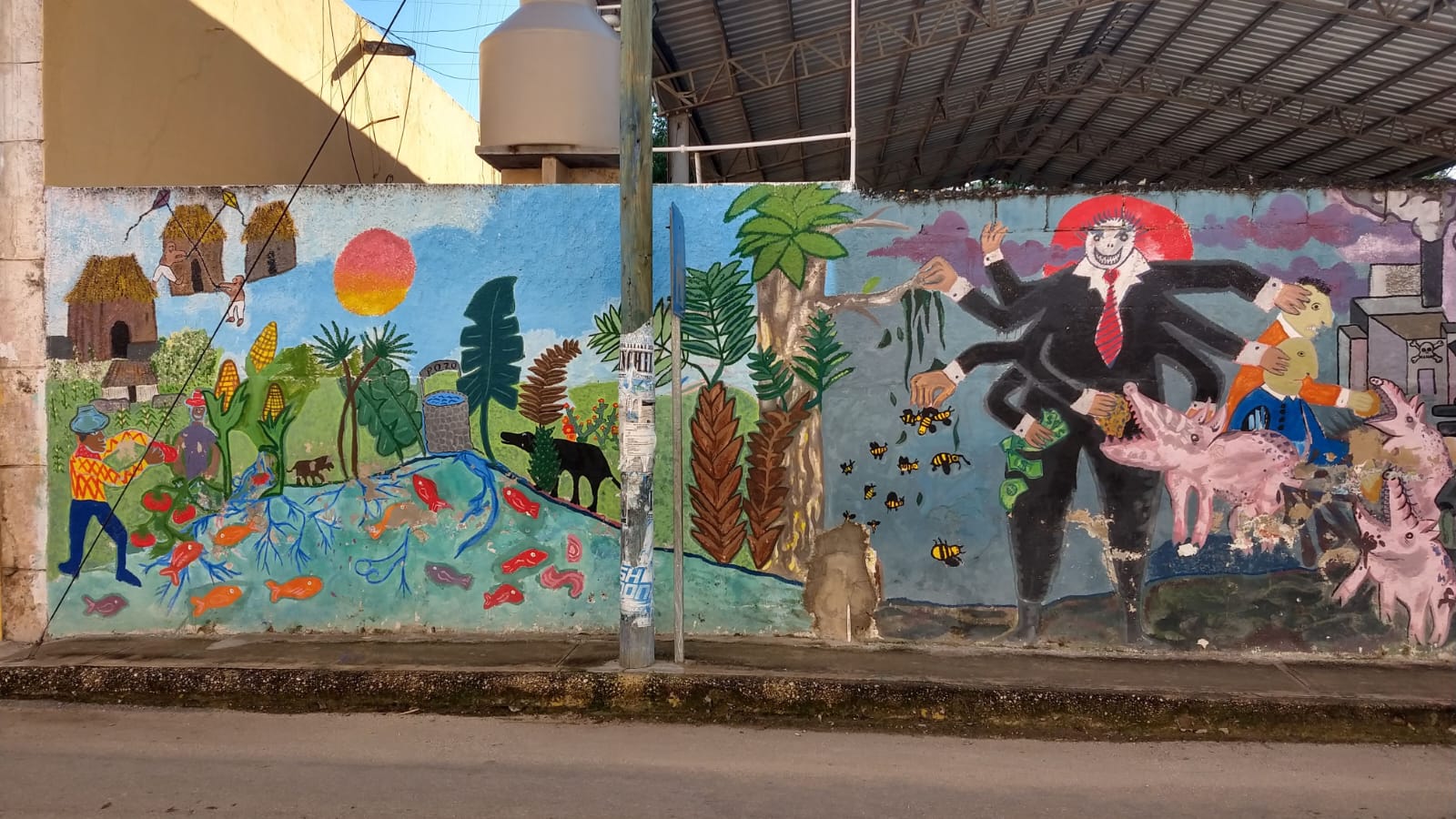
Indifference, threats, or violence from megafarm managers and local authorities against environmental defenders have been common. When people in Sitilpech established a protest camp, which included children, the local police attacked it. More successful was a lawsuit filed on behalf of Mayan children petitioning for their right to a healthy environment and clean water (including a defense of the cenotes). Permits for two megafarms have been removed: one has closed; the other should be winding down, but still contains the pigs. Recently, a third farm in Chocholá was suspended for polluting groundwater, but it has not (yet) been ordered to shut.
So great is the threat to the cenotes and the broader ecosystem from megafarms, the agro-toxics used widely on crops (including genetically modified soybeans), and unplanned urban development that a local NGO, Guardians of the Cenotes (or Kana’an Ts’onot), has initiated a legal case seeking personhood and attendant rights for the Ring of Cenotes.
Industrial animal agriculture entails violence against nature as well as human and more-than-human lives, whether inside or outside the walls of megafarms.”
The role of the rights of nature
This use of the rights of nature (RoN) resonated with Brighter Green, a public policy action tank that works on issues at the intersection of the environment, animal protection, biodiversity, and climate change. As in the Yucatán, CAFOs in Brazil, Colombia, the United States, and elsewhere routinely perpetrate multiple violations of human and nonhuman rights. We have concluded that industrial animal agriculture (reliant on CAFOs) has not received as much attention from the RoN movement as it warrants. It is an area ripe for collaboration among the RoN, more-than-human life, and animal rights movements.
Toward collaborative solutions
In an experimental initiative, Brighter Green has been testing our theory. Our support for Eleisegui’s reporting on the megafarms led to a short documentary, Slaughter-land, which won top prize at the 2025 Yale 360 Environmental Film Festival, and a photo exhibition on megafarms and environmental defenders at the People’s Summit in Belém, which took place in parallel with the COP30 climate conference.
Brighter Green also proposed that the Global Alliance for the Rights of Nature (GARN) include megafarms in their investigation of the consequences of the Maya Train (Tren Maya), and they agreed. The Tren Maya’s construction caused significant deforestation and bisected wildlife habitats, as its steel supports penetrated more than a hundred cenotes, alarming biologists and cave explorers.
Working with Eleisegui and his contacts on the ground, we developed a dossier to integrate with GARN’s Maya Train Resolution, with evidence of the megafarms’ many violations. The resolution, a tribunal judgment from GARN to the Mexican government, called for a moratorium on CAFOs in the Yucatán, respect for rights of nature—including forests, wildlife, and water—and an end to the cruel treatment and exploitation of pigs.
Another demand for redress came in March 2026, when Dr. Marcos Orellana, the United Nations special rapporteur on toxics and human rights, visited the Yucatán Peninsula. (Brighter Green shared with his office the dossier we prepared for GARN.) At the end of his trip, he warned about the creation of “sacrifice zones” in Mexico and the impact of the megafarms on vulnerable groundwater and forests, as well as the criminalization of community activists.
Acknowledging that RoN and MOTH rights include animal rights cracks open possibilities for collaboration to end the impunity of megafarm operators and support just, reciprocal foodways and relationships with the nonhuman world of forests, cenotes, and wildlife that values intrinsic rights across species.”
What next?
What is happening in the villages of Santa Maria Chi, Kinchil, and Sitilpech is, perhaps, a glimpse of a perilous future. Tren Maya freight service will likely begin this year, further facilitating the extraction of pigs, trees, rubber, and other export commodities from the Yucatán. This case reveals that industrial animal agriculture entails violence against nature as well as human and more-than-human lives, whether inside or outside the walls of megafarms.
Acknowledging that RoN and MOTH rights include animal rights cracks open possibilities for collaboration to end the impunity of megafarm operators and support just, reciprocal foodways and relationships with the nonhuman world of forests, cenotes, and wildlife that values intrinsic rights across species.

