AI Rights and Wrongs
From the MOTH Program’s new editorial newsletter, The MOTH Dispatch.
Should we treat AI models as persons with rights? As AI companies race to make their models sound like ever-more-convincing “people” (and as real people confuse chatbots for therapists, friends or partners), the question of AI legal personhood is adding to the general confusion. But it must be taken seriously because it is already having real-world consequences. Some governments have proposed legislation that would allow corporations operated entirely by AI agents, without human supervision, to sign contracts, hire workers, own assets, and pay taxes. Some companies have defended themselves against lawsuits seeking accountability for mental harms allegedly caused by their products by claiming that LLM outputs constitute protected free speech. Meanwhile, a debate is raging among philosophers, technologists, and legal scholars about the nature and moral status of AI models.
For those of us working on human rights and the rights of nature, the question has become inescapable. This is why I accepted an invitation from EAFIT Law School in Medellín, Colombia, to speak with its Dean, Esteban Hoyos, for the Spanish newspaper El País, following the inaugural lecture for their Ph.D. program in law. I will have more to say and write on this topic, but for now I wanted to share a few initial thoughts from my interview in El País.
Esteban Hoyos: For years, you have been one of the most visible advocates for the rights of nature, but you have proposed a different term: “more-than-human rights.” What led you to that line of thinking?
César Rodríguez-Garavito: The rights of nature have been a breath of fresh air for the legal field and the environmental movement. It is a global trend, as evidenced by nearly 700 initiatives on the subject in more than 60 countries. I have worked closely with researchers and advocates on several of these efforts and share with them the language of the rights of nature. The term “more-than-human rights” points to the same idea and seeks to avoid the human-nature dualism. We humans are embedded in the more-than-human world—in the web of life we share with animals, plants, fungi, and other beings. Since we depend on that broader web, human rights also depend on the protection of more-than-human rights.
I’m a lawyer, but also a sociologist, so I care about practical consequences—just as activists and communities do.”
How would you assess the recognition of the rights of nature so far?
It is an idea that went from being marginal to being adopted by courts, parliaments, scientific associations, social movements, and artistic collectives around the world. There are fascinating cases, laws, and declarations regarding the rights of animals, forests, rivers, and other ecosystems—not only in Latin America but also in countries such as Spain, New Zealand, Canada, Sri Lanka, England, and many others. The Inter-American Court of Human Rights has also endorsed it.
The main challenge is to make them a reality. I’m a lawyer, but also a sociologist, so I care about practical consequences—just as activists and communities do. That’s why we’re supporting the implementation of landmark rulings like the one that protected the rights of the Los Cedros forest in Ecuador.
Arguments in favor of animal rights often highlight the similarities between humans and animals, such as sentience and intelligence. What do you make of that idea?
I think it has been useful in practice, for example, in protecting the rights of animals such as primates. Part of my work is dedicated to protecting the rights of whales, alongside scientists who are proving that, beyond intelligence, whales have languages and cultures. But I believe that animal rights should not depend on how much animals resemble us, but rather on the intrinsic value of their lives and their ways of understanding and inhabiting the world. As Henry Beston wrote, animals are neither our brethren nor our underlings: they are other nations that share the planet with us. We should have something like international relations with them, relations that recognize the other precisely for their difference.
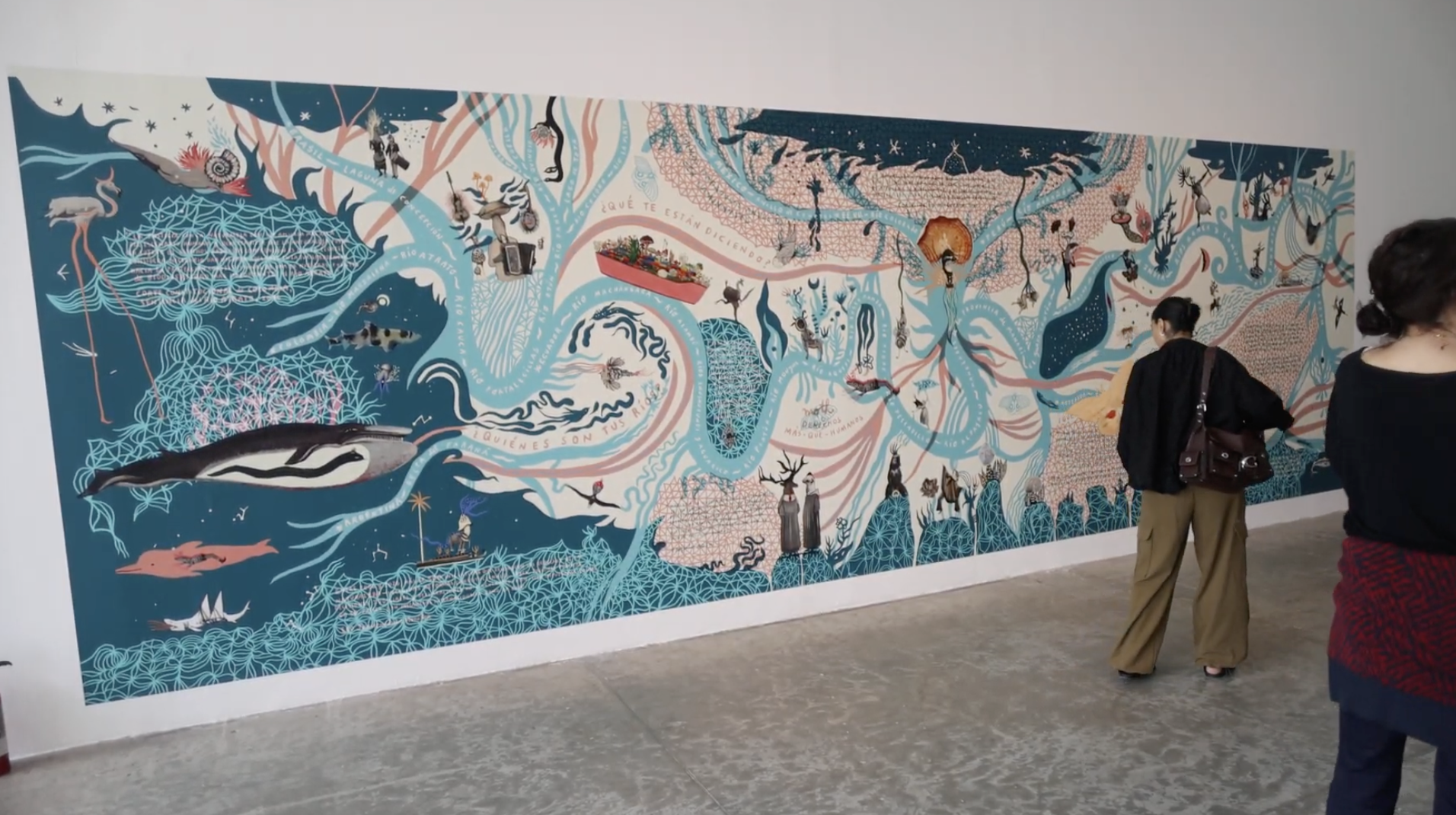
Artwork: Elena Landinez. Photo: Gustavo Graf.
Those who propose treating AI models as persons with rights forget that, unlike nature, technology is a human creation.”
That leads directly to a contemporary and controversial question: Should artificial intelligence have rights?
I am firmly opposed. My main reason is pragmatic. When faced with an idea or a rule, I tend to ask who has more power and who needs protection; I lean toward a theory of rights based on vulnerability. I take the side of the weaker party. Among humans and animals, animals are the most vulnerable, and that justifies protecting them. With AI, the equation is reversed: we humans are the weaker party in the face of increasingly intelligent and autonomous models, which can spiral out of control and endanger both humans and the rest of nature.
But if you yourself have argued that a river can be a subject of rights, doesn’t that leave the door open for someone to argue the same for a sufficiently sophisticated artificial intelligence?
Those who propose treating AI models as persons with rights forget that, unlike nature, technology is a human creation. And that an AI with rights could lead to catastrophic results. As Yoshua Bengio, one of the inventors of AI, has said, that would leave us unable to control it or shut it down if necessary. This is not science fiction. In Argentina, a bill was proposed that would authorize “automated corporations” composed solely of AI systems, which could operate and enter into contracts without human supervision. Who would oversee them? Who would be held accountable if they cause harm?
How do we protect humans from potentially dangerous technology without closing the door on innovation?
My position is not anti-technology. I support small-scale models for specific purposes: translation, editing, even listening to animals. There are projects I’ve been involved in that use AI to understand animal language and the planet’s biodiversity. But I have serious reservations about the kind of general, powerful, and autonomous AI that leading companies are developing. Even many technologists oppose not only AI rights but also the idea of models that resemble people. Chatbots sound like people because their designers have chosen to make them that way, so that we’ll use them more. The same confusion that leads some people to treat AI systems as their therapists, friends, or partners would lead them to treat these systems as people with rights. We need regulations that promote models which maintain a clear distinction between machines and people. But we must act now, because in just a few years the confusion would be such that we might end up handing over control of our lives, our relationships, and our economic and political systems to synthetic intelligences that would surpass us and that we would no longer be able to understand.
Your current work increasingly requires collaboration across disciplines. How does that translate into practice?
It’s essential, and it’s not just a matter of connecting fascinating data from different fields: at its core, there’s a shift in how we view the world and how we study it. I wrote about this for a beautiful exhibition that Mexico’s Museum of Contemporary Art (MUAC) is currently hosting on more-than-human rights. The “more-than-human” shift in the arts, sciences, and law involves understanding that everything is relational: not only that everything is interconnected, but that we as individuals are, ourselves, ecosystems. Unlike Indigenous knowledge systems, modern science has led us to believe that we are separate from the rest of nature. I don’t see how we can seriously study the legal and moral status of human beings without, at the same time, standing in the world in which we are embedded.
What, then, are the most pressing questions facing law and the social sciences in this field in the coming years?
First, ensuring the enforcement of the rights of nature. Second, delving deeper into theories of rights based on vulnerability. Third, regulating AI to slow its development and treat it as a tool.
After such a critical analysis, you insist on ending on a hopeful note. Why?
Because I see many people around the world who are seeking—even yearning—to rekindle their connection with nature. We are living through a difficult time: the climate crisis is worsening, the COPs and the Paris Agreement are piling up setbacks, and the activism embodied by figures like Greta Thunberg is facing a strong backlash. In this context, the rights of nature and other ecocentric ideas mark a shift toward hope, grounded in wonder, curiosity, and the beauty of life on Earth.
This interview was translated using DeepL, a dedicated translation platform, and edited by the author.

